Issued by: Foshan NullSpace Innovation Technology Co., Ltd.
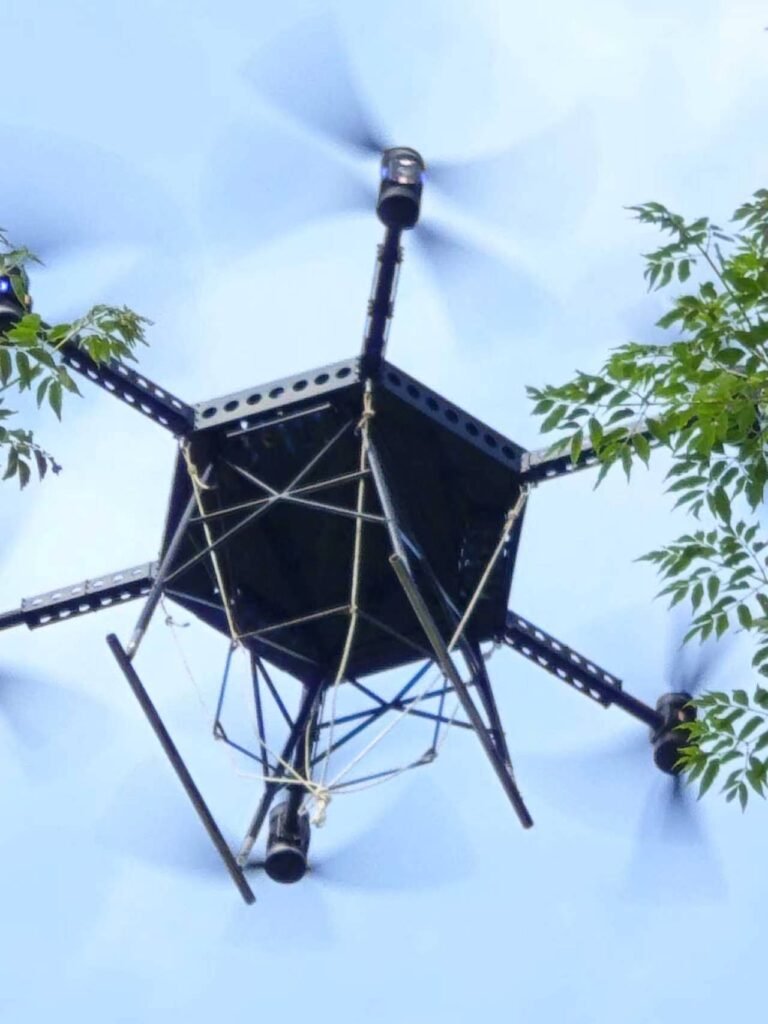
Recently, Foshan NullSpace Innovation Technology Co., Ltd. received the official grant notice from the China National Intellectual Property Administration (CNIPA): A Multi-Rotor Single-Person Vertical Takeoff and Landing Aircraft, independently developed by the company’s core R&D team, has been granted a utility model patent certificate (Patent No.: ZL 2025 2 2437993.5; Grant Publication No.: CN 224916176 U; Application Date: November 18, 2025; Grant Publication Date: October 30, 2026). The utility model patent focuses on the core hardware systems of the single-occupant crewed eVTOL aircraft, including the overall mechanical structure, powertrain layout, and occupant-bearing mechanisms. It marks a key technological confirmation of the company’s capabilities in hardware structure and complete-aircraft engineering development of crewed vertical takeoff and landing aircraft, further improving the company’s independent intellectual property portfolio in the field of low-altitude crewed equipment, and consolidating the enterprise’s technological foundation for future urban air mobility and specialized emergency operations — the National Intellectual Property Administration…
Unlike design patents, utility model patents focus on protecting a product’s construction, mechanical structure, assembly relationships, and functional implementation mechanisms, and are the most direct embodiment of an aircraft’s hardware engineering capability. The multi-rotor single-person vertical takeoff and landing aircraft granted this time was developed through the complete technical solution by an R&D team consisting of Le Ying, Ma Quanjian, Cheng Zhiyong, Xuan Jianming, and He Jinli. Featuring forward engineering design for single-occupant crewed flight scenarios, it focuses on resolving industry pain points such as the load-bearing structure layout, power unit arrangement, human-machine interaction mechanisms, and overall structural reliability against disturbance of multi-rotor crewed platforms. Compared with ordinary industrial-grade unmanned aircraft, a single-occupant crewed aircraft imposes stringent standards on structural strength, redundant safety design, overall space layout, and payload-to-empty-weight balance. The patented technical solution forms unique technical approaches in structural modularity, disassembly and maintainability, overall weight control, and safety-redundancy structural design, while retaining the inherent advantages of the multi-rotor configuration — runway-free vertical takeoff and landing, a small footprint, and strong environmental adaptability — making it suitable for diversified business scenarios such as specialized emergency delivery, mountain rescue, low-altitude mobile operations, and aerial inspection.
From technical solution demonstration, multiple rounds of simulation iteration, and structural prototype trial production, through mechanical performance verification, to patent application, examination, and final grant, the team completed multiple rounds of structural strength verification and overall layout optimization during the R&D cycle, adhering to a development orientation of implementable, iterable, and industrializable technical solutions. The patented technical achievements can be directly applied to subsequent prototype iteration and development, rather than remaining at the theoretical concept level.
Rooted in Sanshui, Foshan, Foshan NullSpace Innovation Technology has long been deeply engaged in the low-altitude equipment sector, with its business covering heavy-payload industrial drones, high-speed interceptor aircraft, customized aircraft frame systems, and the R&D and system-level solutions of single-person vertical takeoff and landing crewed platforms. The company adheres to a development route of independent configuration design, in-house structural development, and independent, controllable core hardware, while simultaneously building a portfolio of design patents and utility model patents, and gradually constructing a multi-level intellectual property protection system covering overall aircraft configuration, mechanical structure, frame craftsmanship, and platform integration. It uses patented technologies to feed back into product iteration and transforms intellectual property into product competitiveness, providing government and enterprise customers with low-altitude equipment products and customized services backed by independent intellectual property rights.
As China’s low-altitude economy continues to accelerate, crewed electric vertical takeoff and landing aircraft (eVTOL), as an important carrier of new quality productive forces, are entering a stage of parallel technological breakthrough and industrialization; hardware structural reliability and independent intellectual property reserves are the core barriers for industry players competing in the market — the National Intellectual Property Administration… This utility model patent grant is an important milestone in NullSpace Innovation Technology’s technical route for crewed aircraft, but it is also a new starting point. Going forward, the company will continue to increase R&D investment, carrying out prototype testing, process optimization, and scenario-adaptation development around the single-person vertical takeoff and landing aircraft, continuously enriching the Suanniao (Falcon) series aircraft product line, polishing high-reliability low-altitude equipment for fields such as low-altitude security, emergency rescue, and specialized operations, and actively working with upstream and downstream industry partners to contribute to the high-quality development of the low-altitude economy in the Guangdong–Hong Kong–Macao Greater Bay Area.
For the industrial drone sector, a design patent is by no means mere “appearance beautification”. An aircraft’s exterior layout directly determines its aerodynamic foundation, overall center-of-gravity range, and payload adaptation capability, and is a core upstream element of the aircraft’s overall scheme design. In an environment of an increasingly regulated low-altitude economy and fierce market competition, independently controllable exterior configuration patents are a concrete embodiment of in-house overall scheme design capability, and also an important intellectual property barrier against homogeneous imitation and for guaranteeing the exclusivity of customer solutions. Throughout the cycle — from scheme demonstration, 3D configuration iteration, multiple rounds of wind tunnel simulation verification, and prototype trial production validation, to patent application, substantive examination, and grant — the team simultaneously completed the matching optimization of configuration and structure, advancing “design confirmation” and “engineering implementation” in parallel, with the patent achievements directly corresponding to mass-production models rather than remaining at the conceptual design level.