
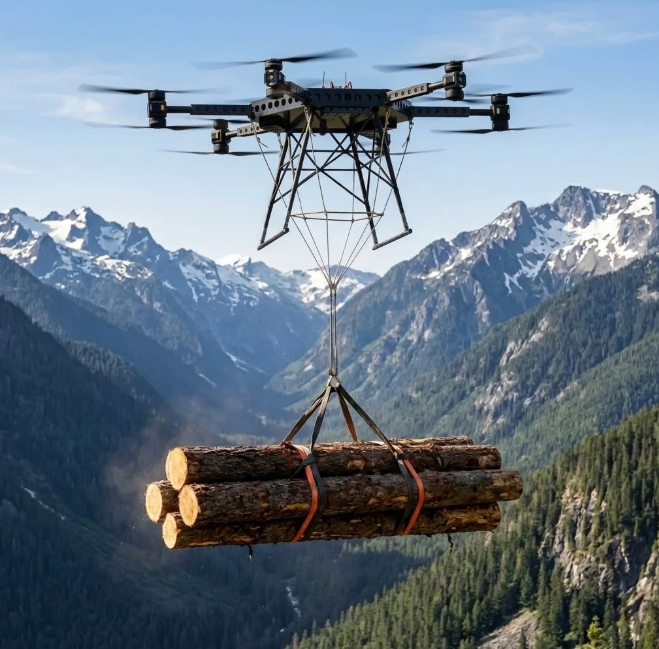
Since the low-altitude economy took off, the term “heavy-lift UAV” has become ubiquitous: platforms rated at 300 kg, 500 kg keep appearing, and the specs on the slides get prettier one after another. But when the machines actually roll into mountain areas, into fire zones, onto island job sites, general contractors and emergency-response units meet a very different reality—
A “500 kg” rating is often the maximum takeoff weight, not the useful payload; in the mountains the power fades and even a 200 kg load shakes; on windy days the aircraft dares not hover, and slope-side drops miss by two or three metres; at high altitude it simply gives up; the flight controller is a parts-bin assembly, so a lost link means a lost aircraft; the sales rep is enthusiastic when you buy, and nowhere to be found after a crash.
The core of a heavy-lift UAV was never “how much can it lift”, but “how much can it lift stably, safely and repeatably”.
In Sanshui, Foshan, there is a local manufacturer that is not fond of buzzwords: NullSpace Innovation Technology. Its positioning is clear—no aerial photography toys, no “flying truck” mythology, only industrial-grade heavy-lift machines that can genuinely fly at job sites, mines, islands and disaster zones.
I. Company Background: A South China Source Factory, Not a Trader and Not a Kit Assembler
NullSpace (Foshan NullSpace Innovation Technology Co., Ltd.) is rooted in Sanshui, Foshan, and works across two capability lines: industrial-grade heavy lift and low-altitude security.
- Payload coverage: a full-gradient platform range from 5 kg to 500 kg
- Three product lines: heavy-lift cargo transport (LK series) / long-endurance line patrol / FalconBird LKHB high-speed interception
- In-house depth: structural design, power matching, flight-control algorithms, hoisting mechanisms, ground control station, and OEM/ODM—the entire chain developed in-house
- Manufacturing capability: in-house final assembly, carbon-fibre frame tooling and an environmental test workshop here in Foshan; customers can visit to inspect prototypes, fly at full load, revise drawings and train their own pilots
Drawing on the mature hardware, composites, motor and ESC supply base of the Pearl River Delta, NullSpace has turned “being close to the supply chain” into a delivery advantage: faster structural changes, faster prototyping, faster spares, faster after-sales response. For project-based procurement in Guangdong and neighbouring provinces, that means no hunting for a factory several provinces away—you can drive to the site in Foshan and align on requirements in person.
They are not a “Taobao frame plus big motor” assembler, nor a trader who merely passes specifications along.
II. The LK Product Matrix: 200 / 300 / 500, and What Each One Is For
Many buyers see “heavy lift” and ask only about the biggest number, but real-world deployment depends on the payload you carry day to day.
1. LK-200 | The high-frequency light-to-medium workhorse with the fastest payback
- Rated useful payload: 200 kg (not peak, not MTOW)
- Use cases: auxiliary materials for mountain infrastructure, power fittings, emergency medicine and food, firefighting agent, island resupply
- Strengths: fast redeployment, small take-off and landing footprint, best cost per sortie
- Field results: in a mountain power project in southwest China, replacing mules and access trails, one day’s output matched dozens of workers—labour costs down 80%, transport efficiency up tenfold
2. LK-300 | The medium heavy-lift all-rounder
- Rated useful payload: 300 kg
- Use cases: hoisting building materials, mine base materials and rock bolts, power tower components, cross-sea delivery to islands, firefighting water bags and extinguisher bombs
- Strengths: primarily all-electric with quick-swap batteries, balancing endurance against maintenance cost
- Best for: projects that repeatedly fly daily loads of 100–250 kg
3. LK-500 | The heavy-lift platform, an “aerial gantry crane”
- Rated useful payload: 500 kg
- Use cases: large structural members, complete equipment sets, heavy emergency supplies, special counter-UAV and surveillance payloads
- Strengths: hybrid petrol-electric option available; frame, power system, ESCs and batteries are all re-engineered for this generation—it is not a 300 kg platform with inflated numbers
- Best for: single sorties that must swallow 350–500 kg pieces, or long-endurance heavy lift with airborne equipment flying at the same time
Rules of thumb for selection:
- Daily 100–250 kg → LK-300
- 350–500 kg single pieces per sortie → LK-500
- High-frequency light lifting, proving the business model first → start with the LK-200
A full 500 kg is the ceiling of capability, not everyday practice. A trustworthy manufacturer asks first “how much wind, what altitude, what are you slinging, how many minutes of flight”, rather than quoting a limit straight away.
III. Why We Dare to Say “Real Payload”: Five Foundations of Heavy-Lift Flight
1. No word games about useful payload
When we state 300 kg / 500 kg, we mean the safe working payload that can be lifted stably, hovered and brought home—excluding the aircraft’s own weight. Altitude, temperature and wind conditions vary, so we keep power margin in reserve; we do not sell “it can yank it up for a moment” as a feature.
2. Redundant power plus in-house AI flight control
A redundant multirotor layout allows a safe return if a single axis fails. The in-house flight-management computer fuses BeiDou, inertial navigation and visual positioning; if the link drops, it switches automatically to inertial mode and returns along the preset route. It does not falter in the electromagnetic clutter of substations, telecom towers or mines.
3. Wind and environment resistance
IP56 protection across the airframe, operable in moderate rain; designed for Beaufort level 7 winds; operating range from -22 °C to +58 °C; a high-altitude version with specially tuned lift output that has been field-tested in Tibet and the uninhabited areas of western Sichuan without payload loss.
4. Intelligent anti-sway hoisting system
Automatic release hooks, sway suppression, and quick switching between drop bays, cargo boxes, extinguisher-bomb racks and adapter plates for special equipment. Contractors hang whatever the job requires, without re-tooling for every new task.
5. Modular payload interface
A standardised airborne interface makes cargo bays, slings, EO/IR gimbals, thermal imagers, spectrum-detection units and counter-UAV equipment plug-and-play. A heavy-lift platform and security payloads can share the same airframe.
IV. Real-World Deployments: Not Demo Flights, but Real Money Saved for Projects
Scenario 1 | Hoisting for mountain infrastructure
The traditional approach: build access trails and cableways, or pack loads on mules—long lead times, costly environmental approvals, high fall risk.
The NullSpace approach: an LK-300 carries tower components, rebar and cement straight to the ridge top and releases them onto the tower position with RTK precision.
The result: at a mountain project in southwest China, delivery to a single point went from half a day to a few minutes, the construction cycle was cut by more than 50%, and the cost and environmental risk avoided by not building roads is plain to see.
Scenario 2 | Emergency delivery for firefighting
Forest fires, landslides, villages cut off—ground forces cannot get in.
LK-200/300 aircraft carry 200–300 kg of firefighting agent, medicine and rescue equipment through gorges at night and in complex airflow for pinpoint delivery; the onboard EO/IR gimbal streams live imagery of the disaster back to commanders for decision-making.
What you gain over “waiting for the water truck to drive around” is not just half an hour—it can be an entire forest, and a handful of families.
Scenario 3 | Island and remote logistics
For coastal islands, offshore platforms and remote job sites, you wait for boats and watch the tide, and resupply cycles are measured in days.
The LK-300/500 delivers tools, chemicals, samples and spares across the water, covering a 30–40 km resupply radius and turning “low-frequency sea freight” into “air freight on demand”.
Scenario 4 | Lifting large structural members
In gorges, on slopes, on plant rooftops—tower cranes and truck cranes cannot get in.
An LK-500 slings heavy members with precise hovering, a lightweight form of aerial lifting that eliminates mobilisation fees for large machinery and the cost of hardening access roads.
Scenario 5 | Integrated low-altitude security (a bonus capability)
NullSpace’s other line, FalconBird LKHB, performs high-speed interception in the 350 km/h class, so the team understands both attack and defence. Heavy-lift aircraft therefore come by design with interference resistance, fail-safe behaviour and encrypted links. Civilian work needs “it can deliver”; security work needs “it can be controlled”. One factory doing both makes system redundancy more honest.
V. OEM/ODM Customisation: One Customer, One Solution for Integrators, General Contractors, Exporters and Research Institutes
NullSpace breaks customisation down in fine detail—it is not “change the colour and call it custom”:
- Payload customisation: stepped adjustment across 50 / 100 / 150 / 200 / 300 / 500 kg
- Configuration customisation: multirotor, VTOL compound-wing or unmanned helicopter architectures
- Environment customisation: no payload loss at altitude, salt-spray corrosion protection, dust sealing, high-humidity heat dissipation
- Function customisation: AI algorithm iteration, multi-aircraft coordination, precision firefighting drops, power-line inspection data capture, open payload interfaces
- Brand customisation: OEM labelling, English ground control station, export compliance documentation, tender technical annexes
- Delivery customisation: prototype → small batch → mass production; bare airframes, power kits and frames can also be supplied separately
For integrators, there is no need to maintain your own flight-control team or carbon-fibre tooling line; for research institutes, open interfaces support test aircraft; for export customers, units leave the Foshan factory already fitted with an English ground station and adapted for overseas airspace.
VI. Why Project-Based Procurement Should Come to NullSpace
Project work fears three things: late delivery, inflated specs, and a crash with nobody accountable.
NullSpace’s response:
- Alignment close to home: a flight-test base at the Foshan factory; customers from South China can be on site the same day to watch a full-load flight
- Verifiable specs: no inflated numbers—we fly in front of you and sign off payload, endurance and wind resistance against measured data
- End-to-end delivery: aircraft + ground station + rigging + training + airspace filing assistance + on-site operations support
- Tender-friendly: technical white papers, test methodologies, qualification documents, performance commitment letters, after-sales maintenance plans
- Local supply chain: hardware, composites and motors from the Pearl River Delta are close by, so drawing changes and prototyping are fast and spare-part lead times are short
- Two lines working together: heavy lift and interception share the same flight-control lineage, so procurement, training and after-sales from one factory cost less and nobody passes the buck
With consumer drones you look at value for money; with heavy-lift aircraft you look at total project lifecycle cost. Batteries, rigging, training, insurance and crash response—those are the real engineering costs.
VII. Typical Customers and Cases (Already Validated in the Field)
- China Southern Power Grid and State Grid mountain power infrastructure: LK-200/300 lifting fittings and tower components, with no access roads built
- Mines in southwest China: holding the route in 10 m/s gusts, delivering base materials to slopes
- Forest firefighting in South China: custom drop bays delivering agent directly onto the fire point
- Coastal islands: cross-sea delivery of medicine and tools, and sample recovery
- Emergency drills: 300 kg of supplies delivered to a cut-off village in three sorties
- Export integrators: LK platforms rebranded and shipped with English ground stations
- Airports and chemical parks: heavy-lift platforms and FalconBird interceptors deployed as one integrated setup
VIII. Procurement FAQ (the Six Questions Contractors Ask Most)
Q1: Can a 300 kg aircraft be upgraded to 500 kg later?
You cannot simply reflash the numbers. The frame, motors, ESCs and batteries are not from the same generation; genuine heavy lift requires redoing the power matching.
Q2: All-electric or petrol?
The 300 kg class is mainly all-electric with quick-swap batteries; for long-endurance heavy lift at 500 kg we recommend hybrid petrol-electric, configured to the mission.
Q3: Who flies it?
A heavy aircraft requires a professional pilot, an on-site commander and airspace filing. NullSpace provides training and on-site support; we do not encourage the boss to fly it himself.
Q4: How should I read a quotation?
Do not ask only for the bare-aircraft price. Batteries, ground station, rigging, video link, insurance, training and maintenance must all be itemised.
Q5: Can this go into a tender?
Yes. We provide technical annexes, qualifications, commitment letters and after-sales plans.
Q6: How is this different from the “internet-famous heavy-lift drone”?
Others talk about “what I can lift”; NullSpace talks about “which day at your site, in what wind, lifting what, and who is accountable if it falls”.
IX. Closing: The Next Stop for Heavy-Lift UAVs Is Engineered Mechanisation
A drone should not be regarded merely as a camera platform. At the top of a power tower, at the edge of a fire, on the crest of an island wave, on a ridge with no road—it is essentially low-altitude engineering machinery.
NullSpace (Foshan) is clear about where it stands:
- A source factory in South China, close to the Guangdong supply chain;
- LK-200/300/500 heavy-lift multirotors, rated at true payload;
- Mountain hoisting, firefighting delivery, island resupply and heavy lifting—all proven in the field;
- Open OEM/ODM customisation, with prototypes, flight tests, after-sales support and tender documentation for project-based procurement.
If you are looking for a heavy-lift UAV that “flies once fine, and flies every day without letting you down”, then instead of studying spec sheets, come to Sanshui, Foshan, hang your site’s cargo on an LK-300 and fly it for real.
Foshan NullSpace Innovation Technology
Foshan NullSpace Innovation Technology Co., Ltd. Address: No. 3 Huiqing Road, Baini Town, Sanshui District, Foshan City, Guangdong Province Tel: +86 186 6452 6891 E-mail: 18664526891@163.com Website: www.cnnullspace.com Main products: FalconBird LKHB-1.5 guided high-speed UAV, heavy-lift security UAV, FPV interceptor UAV, and complete counter-UAV detection and interception systems