
FPV drones have been far too easy to misunderstand over the past two years.
In short videos, it is a racing toy weaving through woods, diving under bridges and hugging the ground; on film sets, it is an “aerial Steadicam” following cars through alleys. But in another context — airport clear zones, chemical tank farms, the airspace above prisons, border lines, concert grandstands — FPV is “the hardest kind of rogue-drone target”: fast, low, agile, able to fly without GPS, and re-tuned until its frequencies are barely recognizable.
Traditional counter-UAS approaches are increasingly strained against targets like these:
- •Jamming guns cannot suppress “fiber-optic FPVs” or “pre-programmed autonomous drones”
- •Net guns are half a beat too slow to catch a 350 km/h modified racing drone
- •Lasers and microwaves are expensive, and constrained by weather and urban scenarios
- •Single-point alarms can “see it” but not “stop it” — the loop breaks at the last meter
So what low-altitude security truly lacks is not another “detection system”, but a hard-kill FPV interceptor that can catch up, lock on, knock the target down, and preserve the evidence.
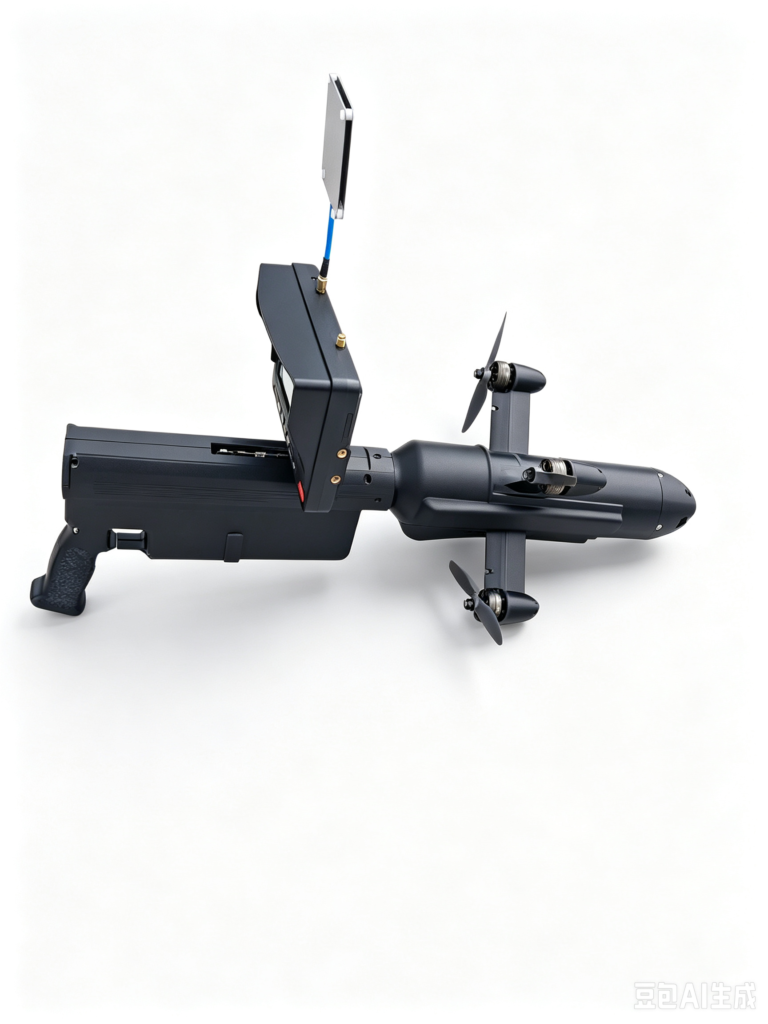
In Sanshui, Foshan, NullSpace Innovation Technology has made exactly this its core business: taking an industrial-grade FPV airframe, fitting a self-developed AI guidance head, and building the “Hayabusa LKHB” series of high-speed interceptor drones.
I. The Maker’s DNA: A Source Factory in Foshan Building “Adversarial-Grade FPV”, Not Reshelled Toys
NullSpace does not compete in the red ocean of consumer aerial photography. Its positioning is hard-edged:
- •Address: No. 3 Huiqing Road, Baini Town, Sanshui District, Foshan
- •Focus: low-altitude security / Counter-UAS / high-speed FPV guided interception / industrial FPV workhorses
- •Capabilities: flight control, AI guidance, video-transmission links, carbon-fiber airframes, powertrain matching, ground stations — all developed in-house
- •Model: source manufacturing + scenario customization + OEM/ODM + system-level delivery
Both are called FPV, but NullSpace’s machines are fundamentally different from racing quads:
A racing drone flies on “human eyes + hands”;
A Hayabusa flies on “AI eyes + in-house flight control” — once a target enters its field of view, it enters a closed loop of tracking, prediction, positioning and interception.
In plain terms: others sell “a camera that can fly”; NullSpace sells “an aerial interceptor that bites the target by itself”.
II. The Hayabusa LKHB Matrix: Translating FPV Speed into “Interception Power”
1. LKHB-1.5 | Individual rapid response — 1.2 kg, airborne in seconds
- •Top speed: 350 km/h, 0-100 km/h in about 1.3 s
- •Weight: 1.2 kg, hand-launched, single-operator
- •Combat radius: 1.5 km (5 km video/control link)
- •Mission endurance: about 3 minutes at full-power interception
- •Guidance: 640 thermal imaging + 1200 TVL visible light, AI dual-spectrum fusion
- •Scenarios: event security, temporary deployment, prison rapid response, sudden rogue drones over industrial sites
The worst thing in an emergency is “waiting for the system to spin up”. Pick this machine up, launch it, let the AI lock the target — it builds a speed advantage within the golden few seconds.
2. LKHB-5 | The standing guard for parks and industrial zones
- •Top speed: 380 km/h, stable cruise at the 150 km/h class
- •Effective capture radius: 5 km
- •Mission endurance: 8 minutes, enough for 2-3 interception runs
- •Dual-spectrum guidance + anti-jamming dual-band link (915 MHz + 2.4 GHz)
- •Scenarios: substations, chemical parks, energy-storage stations, oil and gas depots, chip fabs, logistics hubs
Not a single deterrence fly-around, but 24-hour readiness: radar/electro-optical detection → platform assessment → takeoff → autonomous lock → kinetic neutralization → recorded archive.
3. LKHB-30 / 10-inch hybrid wing | Long-range depth defense
- •Top speed: 400 km/h (390-460 km/h for the high-performance hybrid-wing version)
- •Range: 30-60 km class, ceiling 5,000-6,000 m
- •Endurance: 10 minutes in high-speed interception / 35 minutes on patrol
- •Scenarios: airport clear zones, borders, reservoirs and oilfields, large energy bases
Multi-drone coordination, external radar/electro-optical inputs, long-range patrol + remote suppression — covering “large-airspace depth”.
One shared technology stack: in-house high-speed flight control + AI dual-spectrum guidance + anti-jamming link. Near, medium and far — three tiers, one training program, one spare-parts pool, one maintenance system.
III. Why NullSpace’s FPV “Can Intercept”, Not Just “Can Sprint”
Common flaws of off-the-shelf “interceptor FPVs”: a Betaflight controller with tweaked parameters, analog video transmission, lock lost as soon as the target dodges, blind flight once the link drops.
NullSpace breaks the problem into five hard bones:
1. Fully in-house high-speed flight controller
Optimized for aggressive maneuvering at 300-460 km/h: wind resistance, disturbance rejection, attitude convergence without GPS, controllable landing on single-motor failure. Not just “fast” — “fast and stable”.
2. AI dual-spectrum fusion guidance (fire-and-forget)
- •For targets ≥ 16×16 pixels: detection rate ≥ 95%, recognition accuracy > 85%, false alarms ≤ 5%
- •Tracks micro-targets as small as 3×3 pixels, resistant to shake and occlusion, with fast re-acquisition after interruption
- •Visible-light + infrared dual mode — holds the lock at night, in rain and fog, and against backlight
- •Trajectory prediction + proactive pursuit — keeps up even when rogue drones hug walls, dive under bridges, or escape into the backlight
3. Pure kinetic hard interception, no blast side-effects
No warhead, no net rounds, no fire. After a hit, swap parts and fly again.
Especially suitable for:
- •Chemical / energy-storage sites (no spark-induced secondary disasters)
- •Airports (no debris on runways)
- •Urban business districts (no harm to crowds)
4. Industrial-grade anti-jamming link
915 MHz + 2.4 GHz dual-band control, optional 5.8 GHz video link, control and video separated; near substations, base stations and airport perimeters it switches links automatically in strong electromagnetic environments — no disconnect, no blind flight.
5. A closed evidence loop
H.264/H.265 low-latency streaming, 4K recording + coordinates + timestamps + RTSP archiving — feeds command walls and security platforms directly, so every interception can be traced, reported and used in legal proceedings.
IV. Field Deployment: “Six Real Battlefields” for FPV Interception
1. Airport clear zones
Radar detects the FPV → command platform assesses → LKHB-30 takes off → dual-spectrum lock → shadowing/blocking or kinetic interception → full recording.
No high-power navigation jamming — compliant with clear-zone logic: “not scaring it away, but making sure it never flies a second time.”
2. Chemical / power / energy storage
The concerns: photographed processes, disturbed instruments, any ignition risk.
LKHB-5 stands guard around the clock, auto-identifies within a 5 km radius, prioritizes sound-light warning + blocking + soft measures, with kinetic neutralization only when necessary — no blast side-effects.
3. Major sports events / concerts
Temporary deployment, tight timelines, dense crowds.
Shoulder-launched LKHB-1.5 is combat-ready in 5 minutes, protecting the grandstand, the stage and the spectator areas.
4. Prisons / detention centers
Contraband airdrops, loitering over the compound.
Fixed hangar + automatic recognition + second-level takeoff, on 7×24 automatic standby.
5. Borders / ports of entry
Modified drones hugging the ground to scout, flying even without GPS.
Hybrid-wing long-range patrol + multi-drone coordination, countering cross-border low-slow-small targets.
6. Industrial FPV work extensions (same airframe)
7-inch / 8-inch long-endurance platforms, 16 ms low-latency video, ready to carry thermal imaging, gas detection, loudspeakers or payload-drop modules:
- •GPS-denied close-in reconnaissance in tunnels and utility corridors
- •Life search at collapse sites
- •Bridge steel structures and chemical-plant pipeline inspection
One flight-control foundation, built to “strike” as well as to “probe”.
V. OEM/ODM: Being “The Factory Behind” Security Integrators
NullSpace breaks its FPV capability into customizable modules:
- •Airframe customization: 7-inch / 10-inch / hybrid wing; wheelbase, arms and impact-resistant structures recomputed per scenario
- •Materials & processes: T300/T700 carbon fiber, high-modulus carbon fiber, aerospace aluminum, 316 stainless-steel fasteners
- •Function customization: AI recognition models, dual-spectrum payloads, anti-jamming links, multi-drone coordination firmware
- •Brand customization: white labeling, color schemes, Chinese/English/bilingual ground stations, export-compliance documentation
- •Delivery formats: parts kits / frame + powertrain kits / semi-assembled aircraft / fully white-labeled aircraft
- •System integration: APIs to plug in as the “hard-kill neutralization unit” of existing radar / electro-optical / command platforms
For security integrators: no need to maintain your own high-speed flight-control team — just tell NullSpace “which airspace you need to defend”, and it takes care of structure, guidance, testing and mass production.
VI. The Compliance Era: Interception Is Not “Shoot Whenever You Want”
Low-altitude security touches three red lines: airspace, radio spectrum, and countermeasure authorization.
As a source manufacturer, NullSpace helps project owners draw the boundaries clearly at delivery:
- •Equipment compliance: type certification, test reports, Remote ID / real-name registration documentation
- •Radio compliance: frequency-use licenses, station setup, local approvals
- •Countermeasure compliance: statutory entity qualifications, operating authorization, geo-electronic fencing, operation audits
- •Data compliance: tiered, classified archiving of target tracks, recordings and pilot positions
- •Operational compliance: CAAC operating certificate, pilot licenses, third-party liability insurance, safety manuals
The manufacturer is responsible for “compliant capability + verifiable delivery”; the operator is responsible for “operating within authorization”. NullSpace delivers the technical package, not over-reaching promises.
VII. Why Project-Based Buyers Choose NullSpace
- 1.A source factory in Foshan: South China customers can visit the plant, watch test flights and align requirements the same day
- 1.No inflated specs: top speed / endurance / capture radius rated under real mission conditions, not hover data
- 2.System-level delivery: not selling a drone, but completing the “last strike” of low-altitude defense
- 3.Compliance-friendly: no explosion, low collateral, traceable — fits cities, airports and prisons
- 4.Hardware + software: buy the interceptor alone, or the full LK-SN-15 intelligent counter-drone system
- 5.A closed after-sales loop: pilot training, fast spare-parts swaps, firmware OTA, on-site maintenance, tender document packages
Buying a jamming gun is “shooing it away”; buying NullSpace is “building a low-altitude firewall”.
VIII. The Difference from Ordinary “Counter-Drone Vendors”
| Dimension | Ordinary integrator | Foshan NullSpace |
| Flight control / guidance | Purchased and modified | In-house high-speed flight control + AI dual-spectrum guidance |
| Product positioning | Sells jammers / net guns | Delivers detect-intercept-evidence systems |
| Speed capability | Slow follow-and-film | Hard interception at the 350-460 km/h class |
| Against fiber-optic FPVs | Mostly ineffective | Locks the airframe itself — effective |
| Deployment form | Standalone devices | Individual / vehicle-mounted / hangar / hybrid-wing networking |
| After-sales | Passed on to the manufacturer | Direct from Foshan + test flights + training |
IX. Ask These 5 Questions Before You Buy
- 1.How fast is the target rogue drone, roughly? A modified FPV or an aerial photography drone?
- 1.How large is the protection radius — 1.5 km, 5 km or 30 km?
- 2.Is it a chemical plant / airport / prison? Is blast-free kinetic neutralization required?
- 3.Is radar/electro-optics already in place? Should it connect to the command platform via API?
- 4.Are the pilots trained? Is on-site vendor support needed?
Answer these clearly and NullSpace will line up the models: 1.5 for individual rapid response, 5 for parks and campuses, 30 / hybrid wing for depth.
X. Closing: FPV’s Endgame Is Not “Flying Cool” — It Is “Defending Well”
The hotter the low-altitude economy, the trickier the rogue drones.
The future threat is not “whether there is a drone”, but “whether there is a machine faster, steadier and better at locking on than the rogue”.
NullSpace’s position in Foshan is clear:
- •A source factory in South China, close to Guangdong’s supply chain;
- •The Hayabusa LKHB series of high-speed FPVs — real interception at 350-460 km/h;
- •AI dual-spectrum guidance, pure kinetic neutralization, no explosion, low collateral;
- •Three tiers of defense: individual rapid response / park standing guard / long-range depth;
- •OEM for integrators, systems for government and enterprise, closed loops for airports and parks.
If you are looking for an industrial FPV that “doesn’t just do a demo fly-around, but actually slams rogue drones down” — come to Sanshui, Foshan, and put a target drone under LKHB’s nose for a real flight.
Foshan NullSpace Innovation Technology Co., Ltd.
- •Address: No. 3 Huiqing Road, Baini Town, Sanshui District, Foshan, Guangdong
- •Website: https://www.cnnullspace.com
- •Tel: 18664526891
- •Main products: Hayabusa LKHB series high-speed guided interceptor drones · LK-SN-15 intelligent counter-drone system · industrial FPV workhorses · airframe OEM/ODM · turnkey low-altitude security solutions
Spotting a rogue drone is not hard; what is hard is to chase it down, lock it, stop it, and keep the evidence.
That hardest strike of low-altitude defense is exactly what NullSpace builds.