
If you run an agricultural operation, haul material in the mountains, or work tower cranes on construction sites, you’ve probably had this experience. You buy a heavy-lift drone, fly it happily for the first few months, and then half a year later the motors run hot, the arms wobble, and the frame cracks at the slightest bump. The spec says 300 kg, but at 200 kg it shakes badly enough to make your heart sink.Where’s the problem? It’s that most people shop for a drone like a toy. A drone that genuinely does heavy work should be chosen the way you’d choose a farm truck — it hauls more, it takes a beating, it lasts.This article looks at heavy-lift drone selection through the eyes of a farm truck buyer, and shows you what an “aerial truck” should actually look like.
Where’s the problem? It’s that most people shop for a drone like a toy. A drone that genuinely does heavy work should be chosen the way you’d choose a farm truck — it hauls more, it takes a beating, it lasts.This article looks at heavy-lift drone selection through the eyes of a farm truck buyer, and shows you what an “aerial truck” should actually look like.
This article looks at heavy-lift drone selection through the eyes of a farm truck buyer, and shows you what an “aerial truck” should actually look like.
1. First, Get Clear: Do You Need “Payload” or “Usable Payload”?
Most buyers open with “what’s the maximum it can carry?” — but that question is a trap. Nominal payload ≠ rated payload ≠ usable payload in the field. These three are far apart.
- Nominal (marketing) payload: the limit measured in a manufacturer’s lab, at full charge, with no wind, in a hover. Take it as a reference only.
- Rated payload: the safe figure for long-duration, normal operation with adequate power reserve. This is the number you should actually care about.
- Usable payload in the field: after subtracting the rigging weight, battery degradation, high-altitude effects and headwind — typically only about 80% of the rated figure.
Rule one of buying: always size on the rated payload, and keep at least a 20% safety margin. If you’re lifting 300 kg of timber in the mountains, don’t buy a 300 kg-rated machine — that’s gambling your life on a rope. Buy one rated at 300 kg that still flies steady with 240 kg on the hook. A farm truck never runs at its rated tonnage flat out, and a drone is exactly the same.
2. Impact Resistance: The Drone’s Equivalent of Body Panels
What makes a farm truck trustworthy? A thick frame, solid suspension, and sheet metal that survives knocks. A drone is no different — impact resistance is the baseline for heavy work. Look at three things:
1. Airframe construction: welded, or bolted together? A good heavy-lift drone uses a one-piece molded carbon-fiber body and arms, or a high-strength alloy skeleton, giving the whole aircraft high stiffness and torsional rigidity. Cheap products use thin shells joined with screws and glue — they rattle and loosen as vibration accumulates, and one knock finishes them. The test is simple: press on an arm, twist the frame. If it’s rigid and doesn’t give, it’s built to work.
2. Propellers and power: can it take a fall, or not? Blades should use high-toughness composite material that springs back after hitting the ground instead of shattering. Motors should be sealed against water and dust, so a bit of grit or rain doesn’t ground you. A farm truck can handle bad roads; a drone has to handle the dust and bumps of a rough landing site.
3. Protection for sensors and electronics. The flight controller, ESCs and other “brains” should sit inside independent vibration-damped enclosures, not be left exposed. That way, even when the frame takes a hit, the electronics stay stable — no crash from a single jolt, no lost link from a single bump.
3. Power Redundancy: One More Life, One More Layer of Safety
A farm truck climbing a hill under load keeps engine reserve in hand. A drone needs that even more. Power redundancy is the most fundamental difference between a heavy-lift drone and a consumer drone.Put simply:
Put simply: “can it still fly home with one motor down?” A qualified heavy-lift drone should at minimum be able to return safely after a single motor or single propeller failure. Ask before you buy: is it an eight-arm, sixteen-propeller layout? Can it hold attitude with one or two power units failed? Extra power isn’t extra battery drain — it’s an extra life, especially when you have hundreds of kilos of cargo hanging over your head.
4. Two Workhorses: NullSpace Z300 and Z500
By now you’ve probably noticed that choosing a heavy-lift drone is essentially choosing a farm truck that flies: it hauls more, it takes a beating, it’s dependable. Here are the two main models from NullSpace, so you can see what the specs of a real “aerial truck” look like.
NullSpace Z300: The “Pickup” of Mountain Lifting
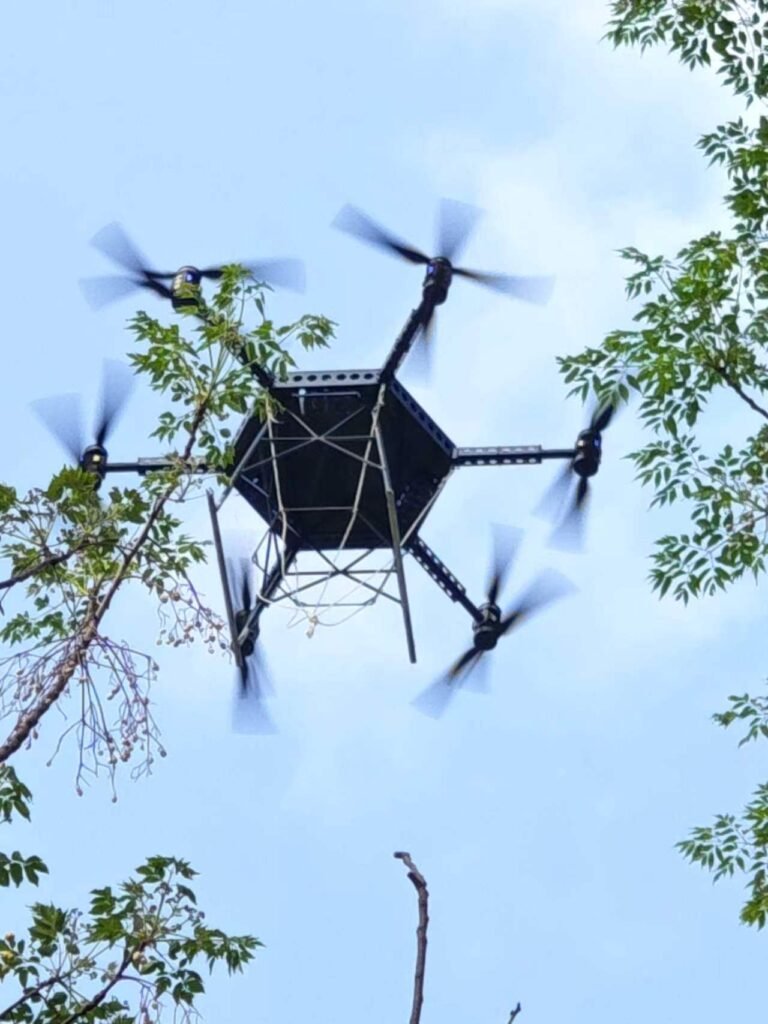
- Rated payload of 300 kg, eight-arm sixteen-propeller coaxial layout, stable return even with one motor failed.One-piece carbon-fiber airframe with folding arms — a single pickup bed is enough to move it between sites.Standard electric release hook system with intelligent anti-sway algorithms; timber and building materials go up steady, accurate, and without swinging.Ample power reserve: plenty of margin remains at altitude, in mountains, and in headwinds — 240 kg on the hook still flies cleanly.
- One-piece carbon-fiber airframe with folding arms — a single pickup bed is enough to move it between sites.Standard electric release hook system with intelligent anti-sway algorithms; timber and building materials go up steady, accurate, and without swinging.Ample power reserve: plenty of margin remains at altitude, in mountains, and in headwinds — 240 kg on the hook still flies cleanly.
- Standard electric release hook system with intelligent anti-sway algorithms; timber and building materials go up steady, accurate, and without swinging.Ample power reserve: plenty of margin remains at altitude, in mountains, and in headwinds — 240 kg on the hook still flies cleanly.
- Ample power reserve: plenty of margin remains at altitude, in mountains, and in headwinds — 240 kg on the hook still flies cleanly.
In one line: in the 300 kg class, it’s the one that hauls the most, runs the fastest, and takes the most abuse — mountains, orchards, power-line components, forestry timber, it covers them all.
NullSpace Z500: The “Heavy Truck” of Heavy Hauling
- Rated payload of 500 kg, extended and thickened arms, reinforced landing gear, purpose-built for large-tonnage work.Ultra-high-strength alloy plus carbon-fiber composite airframe, maximum impact protection rating — construction sites and material yards are no problem.Larger power system and longer-endurance battery packs; even fully loaded it covers a wider operating radius.Supports both internal cargo-bay carrying and external sling modes, so bulk, boxed and bagged supplies all arrive in one trip.
- Ultra-high-strength alloy plus carbon-fiber composite airframe, maximum impact protection rating — construction sites and material yards are no problem.Larger power system and longer-endurance battery packs; even fully loaded it covers a wider operating radius.Supports both internal cargo-bay carrying and external sling modes, so bulk, boxed and bagged supplies all arrive in one trip.
- Larger power system and longer-endurance battery packs; even fully loaded it covers a wider operating radius.Supports both internal cargo-bay carrying and external sling modes, so bulk, boxed and bagged supplies all arrive in one trip.
- Supports both internal cargo-bay carrying and external sling modes, so bulk, boxed and bagged supplies all arrive in one trip.
In one line: when your needs move from “a few hundred kilos” up to “half a tonne,” the Z500 is the heavy truck built to survive a full year of intense work.
5. How to Choose: Match Yourself to the Table
| Your Requirement | Recommended Model | Why |
| Mountain timber and building-material lifting, 200–240 kg per tripNullSpace Z300Enough payload, easy to relocate, tough and impact-resistantMaterial transfer at orchards, tea plantations and farmsNullSpace Z300Agile, pickup-level conveniencePower-line components, lifting of large equipmentNullSpace Z500Half-tonne class, ample heavy-lift reserveBulk material handling at construction and material sitesNullSpace Z500Heavy-truck durability, handles intense useEmergency supplies, high-volume deliveries in mountainous areasNullSpace Z500Long range, high capacity, one trip does the work of three | NullSpace Z300Enough payload, easy to relocate, tough and impact-resistantMaterial transfer at orchards, tea plantations and farmsNullSpace Z300Agile, pickup-level conveniencePower-line components, lifting of large equipmentNullSpace Z500Half-tonne class, ample heavy-lift reserveBulk material handling at construction and material sitesNullSpace Z500Heavy-truck durability, handles intense useEmergency supplies, high-volume deliveries in mountainous areasNullSpace Z500Long range, high capacity, one trip does the work of three | Enough payload, easy to relocate, tough and impact-resistantMaterial transfer at orchards, tea plantations and farmsNullSpace Z300Agile, pickup-level conveniencePower-line components, lifting of large equipmentNullSpace Z500Half-tonne class, ample heavy-lift reserveBulk material handling at construction and material sitesNullSpace Z500Heavy-truck durability, handles intense useEmergency supplies, high-volume deliveries in mountainous areasNullSpace Z500Long range, high capacity, one trip does the work of three |
| Material transfer at orchards, tea plantations and farmsNullSpace Z300Agile, pickup-level conveniencePower-line components, lifting of large equipmentNullSpace Z500Half-tonne class, ample heavy-lift reserveBulk material handling at construction and material sitesNullSpace Z500Heavy-truck durability, handles intense useEmergency supplies, high-volume deliveries in mountainous areasNullSpace Z500Long range, high capacity, one trip does the work of three | NullSpace Z300Agile, pickup-level conveniencePower-line components, lifting of large equipmentNullSpace Z500Half-tonne class, ample heavy-lift reserveBulk material handling at construction and material sitesNullSpace Z500Heavy-truck durability, handles intense useEmergency supplies, high-volume deliveries in mountainous areasNullSpace Z500Long range, high capacity, one trip does the work of three | Agile, pickup-level conveniencePower-line components, lifting of large equipmentNullSpace Z500Half-tonne class, ample heavy-lift reserveBulk material handling at construction and material sitesNullSpace Z500Heavy-truck durability, handles intense useEmergency supplies, high-volume deliveries in mountainous areasNullSpace Z500Long range, high capacity, one trip does the work of three |
| Power-line components, lifting of large equipmentNullSpace Z500Half-tonne class, ample heavy-lift reserveBulk material handling at construction and material sitesNullSpace Z500Heavy-truck durability, handles intense useEmergency supplies, high-volume deliveries in mountainous areasNullSpace Z500Long range, high capacity, one trip does the work of three | NullSpace Z500Half-tonne class, ample heavy-lift reserveBulk material handling at construction and material sitesNullSpace Z500Heavy-truck durability, handles intense useEmergency supplies, high-volume deliveries in mountainous areasNullSpace Z500Long range, high capacity, one trip does the work of three | Half-tonne class, ample heavy-lift reserveBulk material handling at construction and material sitesNullSpace Z500Heavy-truck durability, handles intense useEmergency supplies, high-volume deliveries in mountainous areasNullSpace Z500Long range, high capacity, one trip does the work of three |
| Bulk material handling at construction and material sitesNullSpace Z500Heavy-truck durability, handles intense useEmergency supplies, high-volume deliveries in mountainous areasNullSpace Z500Long range, high capacity, one trip does the work of three | NullSpace Z500Heavy-truck durability, handles intense useEmergency supplies, high-volume deliveries in mountainous areasNullSpace Z500Long range, high capacity, one trip does the work of three | Heavy-truck durability, handles intense useEmergency supplies, high-volume deliveries in mountainous areasNullSpace Z500Long range, high capacity, one trip does the work of three |
| Emergency supplies, high-volume deliveries in mountainous areasNullSpace Z500Long range, high capacity, one trip does the work of three | NullSpace Z500Long range, high capacity, one trip does the work of three | Long range, high capacity, one trip does the work of three |
Remember the dividing line: for 300 kg and below, frequent relocation and scattered work sites, choose the Z300 — it’s as agile as a pickup. Above 300 kg, with concentrated operations and one-trip capacity demands, go straight to the Z500 — it carries load like a heavy truck.
6. A Few Final Words, From the Heart
Choosing a heavy-lift drone works the same way as choosing a farm truck: don’t be dazzled by fancy features. Just ask whether it hauls more, whether it takes a beating, and whether it will still be dependable years from now.
- Hauling more is the hard metric — always leave a healthy margin on rated payload; don’t gamble on a rope.
- Impact resistance is the baseline — airframe structure, blades and electronics protection, none can be skipped.
- Redundancy is what saves you — one more set of power is one more degree of safety.
NullSpace started building heavy-lift drones for a simple reason: so that everyone who makes a living from the mountains, from the land, or from construction can have an “aerial truck” that is as solid, as tough, and as capable of heavy work as a farm truck.
Whether you’re lifting a load of timber or moving half a tonne of building materials, between the Z300 and the Z500 there’s always one that can carry the weight for you.
If you happen to be shopping for an aerial truck right now, get in touch with NullSpace any time. Tell us about your work scenario and we’ll help you find the right match — the model that fits you best.