
The application of drone technology in firefighting mainly includes firefighting in high-rise buildings, fire reconnaissance and rapid response, and multi-scenario auxiliary rescue, and is transitioning from an auxiliary tool to a core combat force. These applications not only expand the height and speed of firefighting operations but also significantly reduce personnel risks, driving the transformation of firefighting and rescue towards intelligence and three-dimensionality.
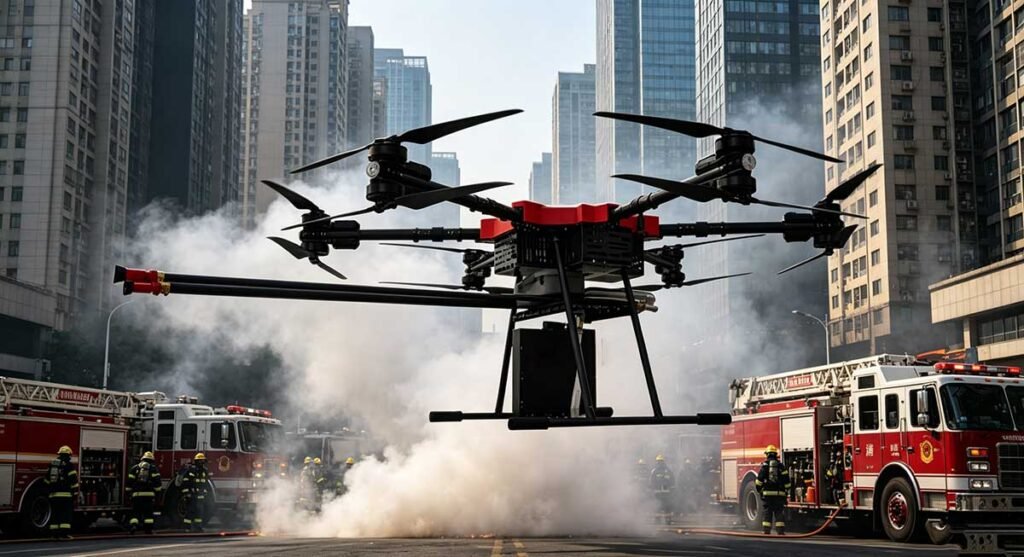
Breaking Height Limitations: Traditional fire trucks often prove ineffective in high-rise buildings, with their operating height mostly limited to around 100 meters. Drones, however, can easily reach hundreds of meters in altitude. On January 23, 2026, Shenzhen Fire Department conducted a test at the 333-meter-high Chengjian Yunqi Building, successfully enabling a firefighting drone to spray water at an altitude of 306 meters, with a flow rate of 16 liters per second and a maximum range of 36 meters.
The key innovation lies in the “automatic aerial hose connection” technology: the test utilized an automatic connection device deployed on the building’s 278-meter-high refuge floor. After the drone towed the hose into the air, its mechanical claw automatically captured and locked the water supply interface inside the building, completing the aerial connection. This is like connecting drones to “aerial water pipes,” allowing them to obtain a continuous water supply from the building’s internal fire protection system, eliminating the limitations of onboard water tank capacity.
More importantly, the water supply pressure is crucial—the mobile pressurization device pre-installed in the refuge floor increases the pressure to 1.5 MPa, equivalent to 15 atmospheres, providing strong power for the water to flow upwards to an altitude of over 300 meters. This combined approach directly addresses the pain points of “inaccessible and weak water pressure” in high-rise firefighting, turning drones into “aerial fire hydrants” and providing a new solution for accurately targeting fires on building facades.
Intelligent Reconnaissance First
In terms of fire reconnaissance, drones can quickly reach high-temperature, densely smoked areas inaccessible to personnel, acting as “aerial eyes.” For example, the Karamay Fire Brigade deployed an “8+1” drone nesting system, achieving a rapid response in the main urban area with “1-minute takeoff and 3-minute image transmission.”
Drones equipped with infrared thermal imagers and other equipment can transmit key data such as heat source distribution and the location of trapped personnel in real time, improving efficiency several times over compared to traditional manual reconnaissance.
This intelligent reconnaissance is not only faster but also safer. Drones replace firefighters in penetrating high-risk environments, directly reducing the risks of interior attack operations. Analysis indicates that 42% of firefighter fatalities in high-rise fires are due to interior attacks, a risk that drones can effectively avoid.
Simultaneously, reconnaissance data can be combined with building information models to generate 3D fire scene maps, helping command centers formulate operational plans within 10 seconds, achieving precise rescue with a “know your enemy, know yourself” approach.
Drone applications have extended to daily monitoring and auxiliary rescue. In industrial parks or forest areas, drones, through automatic navigation and thermal imaging technology, can identify heat sources as small as 1 meter in diameter with an accuracy rate exceeding 95%, reducing fire detection time from the traditional 7 minutes to 42 seconds, facilitating early and small-scale fire suppression.
Furthermore, drones can be equipped with loudspeakers to guide personnel, deliver emergency supplies, and even carry parachutes to ensure safe emergency landings in case of malfunctions. In scenarios such as chemical plant fires, they can collaborate with ground equipment to establish water curtain defenses, buying time for manual response.
These technological breakthroughs and practical applications demonstrate that drones are evolving from standalone equipment into key nodes in intelligent fire protection networks, propelling fire and rescue into a new stage of integrated air, space, and ground operations.