
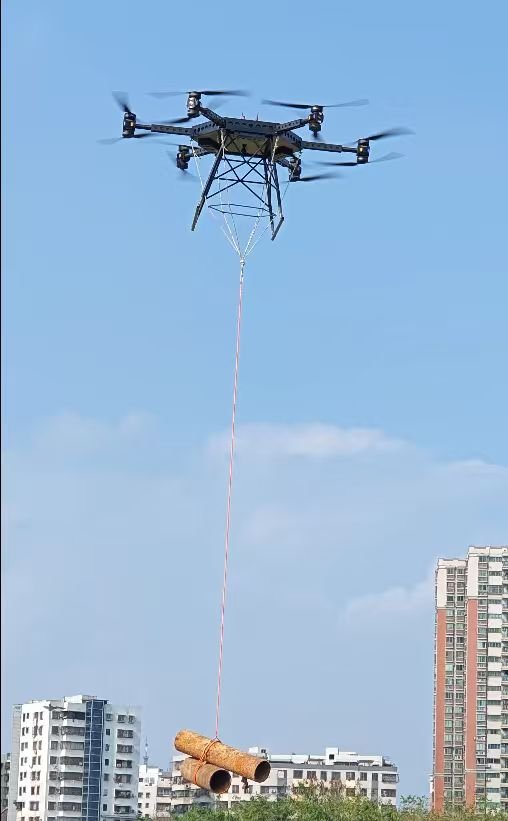
Introduction: When the “Low-Altitude Economy” Tide Recedes, Who Is Swimming Naked?
Over the past two years, the low-altitude economy has been an absolute capital-market buzzword. But behind the glitzy product launches and polished promotional videos, the bosses actually doing engineering work on the front line all keep their own ledger:
Many heavy-payload drones can fly at trade shows, but not on job sites; they can fly for the camera, but not in strong winds.
A machine rated at 500 kg maximum takeoff weight may only deliver 200 kg of effective payload at 3,000 meters above sea level; a claimed Force-7 wind resistance can be defeated by a single patch of turbulence that locks up the flight controller outright; and after-sales service is another story entirely — when the machine crashes, the manufacturer blames the operator.
In “mission-critical” scenarios such as mountain infrastructure, emergency firefighting, and island resupply, a drone is not a toy — it is a production tool. The first attribute of a tool is always reliability; specifications come second.
As an industrial drone source manufacturer rooted in Foshan, Null Space Innovation Technology does not play games. Our LK-200 / LK-300 / LK-500 heavy-payload multirotor series was designed from day one to abandon…
Today, we will not talk about concepts — only about “how to save you money, how to help you compress your schedule, and how to make sure the machine never fails you at the critical moment.”
I. Doing the Math: Why Heavy-Lift Drones Are a “Must-Have,” Not a “Novelty”?
When general contractors first encounter heavy-lift drones, their first reaction is usually: “These things are expensive — let me wait and see.”
But once you shift your perspective from “procurement cost” to “total life-cycle cost of the project (LCC),” the conclusion flips completely.
Scenario A: Power Transmission Tower Construction in the Southwest Mountains
Traditional solutions:
- Building temporary access roads: costs RMB 300,000–800,000 per kilometer, and requires forestry and environmental approvals (3–6 months lead time).
- Mule-train transport: each mule carries about 150–200 kg per day at roughly RMB 800–1,200 per day, and is heavily constrained by terrain and weather.
- Ropeway/cable transport: high installation cost and poor flexibility — once the delivery points change, the ropeway is almost written off.
The Null Space LK-300 solution:
- Lifts 200–300 kg of tower steel and fittings per flight.
- Flies from the foot of the mountain to the summit in 3–5 minutes one way.
- One day of operations completes what used to take a 20-person crew plus a mule train a full week.
- Hidden gains: no road construction means saving massive approval costs and road-hardening expenses; a 50% shorter schedule means the revenue of energizing the line earlier and a sharp drop in labor and site-management costs.
Scenario B: Coastal Island / Offshore Platform Resupply
Traditional solution:
Wait for shipping schedules and tides. A single resupply run — from request to delivery — takes 2–3 days at best, or up to a week. When supplies must be rushed in ahead of a typhoon, all you can do is watch and worry.
The Null Space LK-500 solution:
- Direct over-sea flights with a 30–40 km range, covering the vast majority of near-shore islands and platforms.
- Direct airdrop of 300–500 kg heavy spare parts, medicine, and fresh produce.
- Compresses “week-level” resupply down to “hour-level.”
Conclusion: Heavy-lift drones are not “window dressing” — they are a disruptive productivity tool that replaces high-cost traditional transport methods. As long as your project involves any of the three factors “complex terrain, no road access, time-critical”…
II. The LK Series in Depth: Not a “Scaled-Up” Design, but a “Reinvention”
Many competitors’ approach is: take a 50 kg-class frame, thicken the carbon fiber, swap in bigger motors — and dare to call it a 300 kg heavy-lift machine. That is extremely dangerous.
Null Space’s LK series is an entirely new platform built on recalculated aerodynamics, a re-engineered powertrain, and a rewritten flight-control stack.
1. LK-200: The High-Frequency, Lightweight “Mule-Train Replacer” for Mountainous Terrain
- Core logic: make up for limited single-lift payload with high flight frequency.
- Typical workloads: power-line fittings, telecom base-station equipment, small firefighting equipment, emergency medicine.
- Technical highlights: folds down to fit in a pickup truck and has extremely low takeoff/landing-site requirements (only a flat 5×5 m patch needed). In actual operations in the southwest mountains, the LK-200’s daily turnaround rate (flights/day) is several times that of heavy…
2. LK-300: The All-Rounder — the “Universal Trade” of the Engineering Crew
- Core logic: the optimal balance between payload, endurance, and maintenance cost.
- Typical workloads: construction materials (rebar, precast concrete), mine-slope repair materials, fire hoses / fire-extinguishing bombs.
- Technical highlights: a modular quick-swap battery system. On the job site, battery swaps take under 3 minutes; paired with on-site generator charging, it enables continuous “machines never sleep” operations.
3. LK-500: The Heavy-Lifting Platform — a Gantry Crane in the Sky
- Core logic: solve the bottleneck problem of “oversized items that cannot get up there.”
- Typical workloads: large machinery (e.g., small generators, water pumps), heavy structural components, and boxed strategic supplies.
- Technical highlights: a gasoline-electric hybrid option is available. For missions requiring long endurance and heavy payload at the same time (e.g., cross-strait delivery), the hybrid system completely eliminates the range anxiety of pure-electric heavy-payload flight. The airframe is also…
III. Safety Redundancy: Why We Dare to Fly in Force-7 Winds?
What engineering procurement fears most is “an accident.” Null Space’s safety design philosophy is: assume that any component can fail, then design the aircraft so that “even a failure must not become a crash.”
- Powertrain redundancy: multirotor layout — the aircraft can return safely with a single rotor arm failed. This is not a software simulation; it has been verified in actual flight tests.
- Link redundancy: BeiDou short-message + 4G/5G + frequency-hopping radio, three backup links. In deep mountain gorges and island signal dead zones, you may lose a link but never lose contact.
- Intelligent sway suppression: the greatest fear when lifting heavy loads is the “pendulum effect.” Our in-house flight controller has a built-in adaptive anti-sway algorithm: with a 300 kg load hanging, the swing amplitude in hover stays within 5 degrees, ensuring precise delivery.
- Environmental resilience: IP56 protection rating — works as usual in moderate rain, sandstorms, and salt-spray environments. We even offer an optional full-airframe salt-spray anti-corrosion coating for island customers.
IV. More Than Selling Machines: OEM/ODM and Project-Based Procurement, the “Null Space Way”
As a source manufacturer, we know that different customers’ needs are worlds apart. Null Space offers three cooperation models:
Model 1: Standardized Procurement (Turnkey Project)
- Suited for: end users such as emergency-management departments, power bureaus, and mining groups.
- Includes: complete aircraft + ground station + full rigging set + pilot training + airspace application assistance + one-year warranty.
- Advantage: move-in ready — receive the goods today, start flying on the job site tomorrow.
Model 2: OEM/ODM Customization (Brand Empowerment)
- Suited for: drone traders, integrators, and overseas distributors.
- Services:
- Hardware customization: payload, endurance, airframe color, logo.
- Software customization: English/multilingual ground station, mission-specific algorithms (e.g., precision firefighting, automated inspection routes).
- Qualification support: assistance providing test reports and technical white papers to support your bids and tenders.
- Advantage: you handle the market and channels; we make sure the machines are built right and the specifications are real.
Model 3: Project-Based Joint Development (Deep Binding)
- Suited for: research projects with special operating conditions, defense-industry supporting programs, and large infrastructure general contractors.
- Services: starting from requirements analysis, we define the product together. For example, when a mining customer needed “high-temperature resistance + dust protection + a custom lifting rig,” we provided full-process service from prototype to small-batch delivery.
- Advantage: shared technical risk and clear intellectual-property ownership.
V. Why Choose Null Space in Foshan? (Our Moat)
- Geographic advantage: Foshan is a heavyweight of Chinese manufacturing, inside the Pearl River Delta’s 2-hour supply-chain economic circle. Motors, ESCs, carbon fiber, precision machining — all within arm’s reach. That means faster design revisions, faster prototyping, and faster spare-parts response.
- Shared technology roots: we also develop the “Falcon LKHB” high-speed interceptor drone. A manufacturer that builds “interceptors” also builds “delivery” platforms — our understanding of flight-control robustness, disturbance rejection, and failure protection goes far beyond that of aerial-photography-only makers.
- Pragmatic culture: we hire no celebrity endorsements and hold no lavish launch events. The money goes into R&D and the supply chain, and the margin goes back to the customer.
- Transparent specifications: our commitment: all rated payloads are Safe Operating Loads (SAL), excluding airframe weight, with the test environment (altitude, temperature, wind speed) explicitly stated.
VI. Customer Testimonials (Simulated Scenarios — Replace with Real Cases)
Equipment Director of a power engineering company in southwest China:
“In the past, with a ropeway, erecting it at a single site took a week. Since we started using Null Space’s LK-300, our slogan has been ‘tower steel flies up, people walk below.’ The schedule was compressed by 40% — and most importantly, we no longer have to build roads…”
Logistics officer of a coastal island management committee:
“When a typhoon sealed off the sea, the blood-pressure medication on the island ran out. We used to wait for a boat; now the LK-200 flies it over in 20 minutes. This isn’t about saving money — it’s about saving lives.”
CEO of a Southeast Asian drone distributor:
“We compared five Chinese factories, and only Null Space was willing to redesign the airframe’s anti-corrosion process for us and provide a fully English flight-control interface. Their OEM service is professional, and their response speed is top-tier in the Pearl River Delta.”
VII. Next Step: We Invite You to Run a “Stress Test”
Numbers on a spec sheet are no substitute for seeing it with your own eyes.
We extend an invitation to all potential partners:
Bring your cargo to our flight-test base in Sanshui, Foshan.
- Want to lift 200 kg? We’ll hang sandbags and show you on the spot.
- Want to simulate strong winds? We have wind-tunnel test data as well as outdoor wind-resistance test flights.
- Want to discuss customization? Our chief engineer will be on site, sketching solutions on the spot.
Contact Us
Foshan Null Space Innovation Technology Co., Ltd.
- Address: No. 3 Huiqing Road, Baini Town, Sanshui District, Foshan City, Guangdong Province
- Tel/WeChat: 18664526891
- Email: 18664526891@163.com
- Website: www.cnnullspace.com
Main products:
- LK-200 / LK-300 / LK-500 heavy-payload multirotor drones
- Industry solutions: mountain lifting / firefighting delivery / island resupply
- OEM / ODM customization / project-based procurement / non-standard airframe and complete-aircraft contract manufacturing
- Falcon LKHB high-speed interception and counter-UAS system