
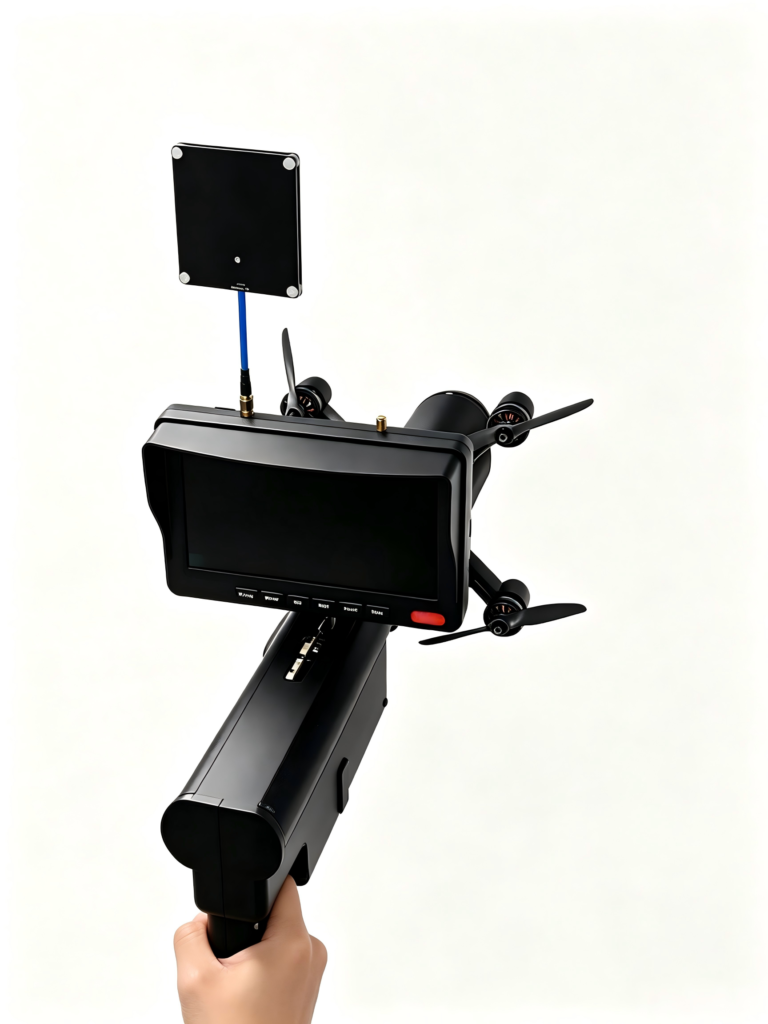
When a modified FPV drone sweeps across an airport runway at 150 km/h, when a fiber-optic-video “black flight” racing drone circles over a chemical park on a reconnaissance run, when an unidentified aircraft suddenly appears above a concert grandstand — traditional “soft-kill” countermeasures are failing across the board. In 2025, China’s police drone market reached RMB 8.64 billion, and the public-safety drone market exceeded RMB 12.86 billion. At the same time, the number of low-altitude security incidents caused by FPV drones has climbed in step. High-speed FPV interceptor drones and hard-kill equipment are shifting from “optional” to “mandatory.”
01 Industry Pain Points: Low-Altitude Security Is Entering the “Hard-Kill” Era
In 2026, low-altitude security threats are no longer as simple as “tourist aerial photography.” They are high-frequency risks spanning airports, energy facilities, sporting events, borders, and corrections:
Modified FPV drones intruding into airport clear zones, forcing flights to divert or be delayed;
Racing drones circling chemical plants and power stations to film processes and data, creating espionage risk;
Unidentified aircraft appearing above concert and stadium grandstands, putting crowd safety under pressure;
GPS-disabled modified drones, fiber-optic FPVs, pre-programmed autonomous-route drones, and low-altitude swarms are spreading into civilian scenarios.
Why do traditional countermeasures fail? Jamming guns cannot catch high-speed targets and are essentially useless against autonomously flying drones; net-capture drones lack the speed to stop modified FPVs; laser weapons degrade in rain, fog, and dust, and are costly to deploy; and large-area air-defense equipment offers extremely poor cost-effectiveness against low, slow, and small targets. The underlying logic of low-altitude defense must shift from “soft deterrence” to “hard kill” — and the high-speed FPV interceptor drone is precisely the core vehicle for this “last line of defense.”
02 Who We Are: Foshan Nullspace Innovation Technology
Foshan Nullspace Innovation Technology Co., Ltd. is headquartered in Baini Town, Sanshui District, Foshan City, Guangdong Province, and is an R&D and manufacturing enterprise focused on counter-UAS systems, high-speed guided interceptor drones, and low-altitude hard-kill defense equipment.
We are neither a consumer drone manufacturer nor an integrator that simply assembles “jamming guns + loudspeakers.” Our in-house capabilities cover high-speed flight controllers, visible-light + infrared dual-sensor AI guidance, anti-jamming data links, carbon-fiber high-speed airframes, and closed-loop networked systems integrated with radar, electro-optics, and command platforms. In one sentence: others sell you an interceptor drone that can fly; we deliver a complete low-altitude defense system that unifies “detection and engagement.”
03 Product Matrix: The LKHB Series — Near, Mid, and Long-Range Three-Layer Defense
Built around the same flight-control and AI-guidance technology stack, the LKHB series covers every mission tier, from rapid individual response to deep, long-range defense:
| Model | Positioning | Max Speed | Key Capabilities | Typical Scenarios |
| LKHB-1.5 | Rapid individual response | 350 km/h | 1.2 kg all-up weight, hand-launched catapult takeoff, 1.5 km combat radius, 0–100 km/h acceleration in just 1.3 s | Sporting events, temporary duty, prison emergencies |
| LKHB-5 | Fixed-site garrison | 380 km/h | 5 km video transmission range, 8 min of practical endurance, dual-sensor AI guidance | Substations, chemical parks, warehouses, commercial districts |
| 7-inch standard / long-endurance | Short- to medium-range base defense | 300–400 km/h class | AI composite guidance, anti-jamming data link, extended patrol radius | Industrial plants, ports, correctional facility perimeters |
| 10-inch blended wing / LKHB-30 | Long-range deep defense | 390–460 km/h | 35–60 km class range, 5,000–6,000 m practical service ceiling, multi-aircraft coordination | Airport clear zones, borders, key energy sites |
From “second-trigger individual interception” to “multi-aircraft coordination covering a 60 km depth,” the LKHB series delivers seamless layered protection on a single technology stack.
04 Core Technology Breakdown: Five In-House Capabilities
The technical bar for high-speed FPV interceptor drones is far higher than that of ordinary consumer racing drones. The core barriers of the LKHB series are reflected at five levels:
In-house high-speed flight controller: not a modified open-source flight controller, but deeply optimized for high-G maneuvering above 350 km/h, strong wind disturbance, and jamming suppression;
Dual-sensor AI composite guidance: a 640-pixel uncooled infrared thermal imager plus a 1200TVL visible-light camera, capable of locking onto targets as small as 3×3 pixels, with target recognition accuracy ≥85% and a false-alarm rate <5%; resistant to occlusion, vibration, and decoys, with terminal impact accuracy at the 0.3-meter level;
Anti-jamming data link: 915 MHz / 2.4 GHz / 5.8 GHz multi-band redundancy, maintaining stable communications in strong electromagnetic environments such as industrial zones, substations, and borders;
Pure kinetic hard kill: no explosive warhead, no fragmentation, no risk of secondary deflagration; after interception, damaged components can be replaced and the aircraft reused, giving a long-term cost of ownership significantly better than one-shot net-capture projectiles or missiles;
System-level closed loop: radar/electro-optical detection → AI classification (distinguishing birds, kites, consumer drones, and FPV types) → threat assessment on the command platform → interceptor launch → tracking and impact → 4K video, geotagged timestamps, RTSP streams, and full event archiving.
05 Countermeasure Comparison: Why High-Speed Kinetic Interception Is the “Endgame”
Put the mainstream counter-UAS methods in a single table, and the conclusion becomes very clear:
| Countermeasure | Vs. Autonomous FPV | Vs. Fiber-Optic FPV | Urban Compliance | Cost-Effectiveness | Operational Deployment |
| Jamming gun | Poor | Ineffective | Spectrum-control risk | Medium | Deterrence only |
| Navigation spoofing | Poor | Ineffective | High compliance risk | Medium | Soft kill |
| Net capture | Poor | Poor | Acceptable | Low | Cannot catch high-speed drones |
| Laser hard kill | Good | Good | Heavily weather-dependent | High system cost | Suited to fixed key sites |
| High-power microwave | Good | Good | Electronic collateral damage | Medium | Difficult to deploy in urban areas |
| High-speed kinetic interception (LKHB) | Good | Good | No explosives, minimal collateral | High | Individual, vehicle-mounted, or hangar |
The conclusion is straightforward: soft-kill methods are the first layer of deterrence, while high-speed kinetic hard kill is the fallback engagement capability. Especially against fiber-optic FPVs and pre-programmed autonomous drones that do not depend on a remote-control link, only a high-speed FPV interceptor drone that physically locks onto the target itself can truly complete the “shoot-down.”
06 Scenario × Pain Point × Solution: One System Covering Six High-Incidence Scenarios
| Scenario | Core Pain Point | Nullspace Solution |
| Civil aviation airports | Black-flight FPVs intruding into flight paths; jamming guns may interfere with airliners | Radar–electro-optical linkage + LKHB-5/LKHB-30 hard kill, no explosives, fully traceable |
| Chemical / power / energy storage | Aerial photographic espionage, instrument interference, fire hazards | LKHB-5 on 24-hour station duty, AI distinguishing birds and kites from hostile drones |
| Major sporting events / concerts | Rapid deployment required; dense on-site crowds | LKHB-1.5 portable catapult launch, combat-ready within 5 minutes |
| Borders / ports | Low-altitude modified reconnaissance aircraft; large defensive depth | 10-inch blended-wing long-endurance platform, multi-aircraft coordinated deep-area patrols |
| Prisons / detention centers | Drone delivery of contraband, perimeter breaches | Fixed automated hangar, AI recognition, second-level launch readiness |
| Industrial parks / chip fabs | Espionage threats, low-altitude loitering, remote operation | Integrated radar–electro-optical–interception, compatible with existing security management platforms |
07 Benchmark Cases
Civil airport clear zones: radar detects an FPV target → threat assessment on the command platform → the LKHB series executes a hard kill, with video records across the entire process for after-action traceability;
Energy and chemical sites: 24/7 unattended defense for power plants, substations, and oil and gas facilities, greatly reducing the staffing burden of manual watchkeeping;
Major sporting events and concerts: portable deployment quickly covers grandstands, stages, and spectator areas;
Border areas: long-endurance blended-wing platforms conduct deep patrols and engagements against cross-border modified drones;
Industrial parks and correctional facilities: fixed hangar deployment enabling 24/7 automatic alert-standby defense.
08 Frequently Asked Questions (FAQ)
Q1: Can it counter fiber-optic FPVs and pre-programmed autonomous drones?
A1: Yes. The LKHB series relies on electro-optical and infrared AI to lock onto the physical target itself, independent of the control link, and is equally effective against fiber-optic FPVs and autonomous-route drones.
Q2: What advantages does hard kill have over jamming guns?
A2: Jamming may fail against autonomous drones that do not rely on a link; hard kill achieves a genuine “shoot-down” through pursuit, lock-on, and physical impact.
Q3: Will debris falling after interception injure people?
A3: Interception missions are typically executed in safe airspace after the target is detected; we work with customers to design interception flight paths and debris descent control protocols.
Q4: Is the top speed of 460 km/h an exaggeration?
A4: The LKHB-1.5 has a measured flight speed of 350 km/h; the 10-inch blended-wing and high-performance 7-inch models reach peak speeds of 390–460 km/h, outperforming the vast majority of modified civilian FPVs on the market.
Q5: Can it be integrated with existing radar, electro-optical, and command platforms?
A5: Yes. Standard interfaces and APIs are provided so it can be integrated into existing security architectures as a hard-kill execution module.
Q6: Is on-site testing supported before purchase?
A6: Yes — including factory visits in Foshan, hardware demonstrations, live interception tests, operator training, and after-sales maintenance.