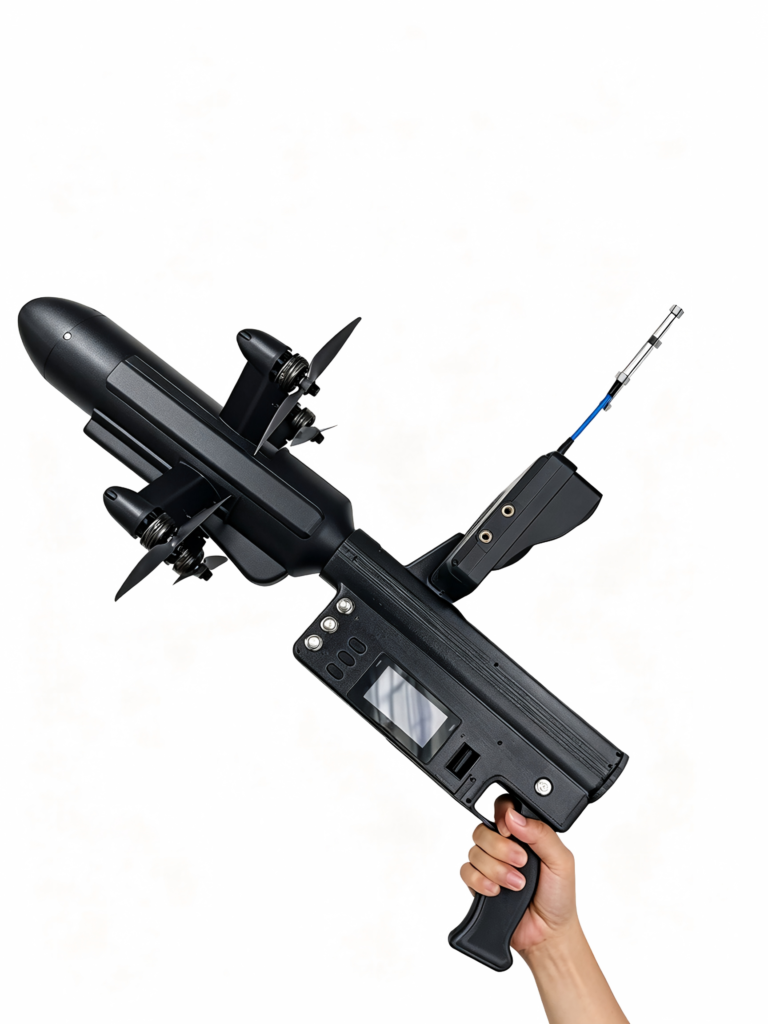
When purchasing anti-drone systems, the highest cost is not the hardware itself, but the scenario where “the system appears capable of interception yet fails to stop rogue drones during actual incursions”.
As an indigenous R&D manufacturer based in Foshan, NullSpace Innovation Technology Co., Ltd. of Foshan breaks down the most common pitfalls encountered by purchasers. This is not an advertisement but a practical selection guide.
Pitfall 1: Treating an “anti-drone system” as merely a jamming gun
Many institutions receive budget approval for “anti-drone equipment”, only for procurement staff to end up buying handheld jamming guns.
A complete anti-drone system consists of at least five layers:
- Detection: Radar / Electro-optical / RF Spectrum / Acoustic sensors
- Identification: Distinguishing birds, kites, consumer-grade drones, modified FPV drones, and pre-programmed autonomous-route drones
- Decision-making: Observation, tracking, warning and interception
- Countermeasures: Soft-kill (jamming, deception) or hard-kill (net capture, kinetic impact, laser)
- Forensics: Video recording, coordinate logging, timestamping and event archiving
NullSpace’s perspective: Vendors selling only jamming guns are merely “countermeasure tool suppliers”. Genuine anti-drone system manufacturers deliver closed loop capabilities covering detection, identification, interception and forensics.
Pitfall 2: Assuming jamming guns can neutralize all drones
Traditional radio-frequency jamming works against ordinary consumer-grade camera drones, yet it fails against the following three categories:
- Modified FPV racing drones (frequency-hopping, proprietary communication protocols)
- Pre-programmed autonomous route drones (operating without remote control after take-off)
- Fiber-optic FPV drones (control and video transmission run over physical fiber optics with barely any wireless signal radiation)
There is a frank industry saying: Fiber optic and fully autonomous drones render jamming guns ineffective.
✅ NullSpace solution: Deploy Falcon LKHB / LK-SN-15 for AI-guided hard interception. The system locks onto the physical drone platform instead of suppressing radio signals, enabling continuous tracking even against autonomous-route and fiber optic FPV drones.
Pitfall 3: Focusing solely on “top speed of 460 km/h” while ignoring acceleration and guidance
A top-speed figure of 460 km/h on spec sheets does not guarantee real world interception performance. Key performance indicators include:
- 0-100 km/h acceleration time (1.3 seconds for the LKHB-1.5)
- Whether AI autonomous guidance is implemented, or manual joystick-driven tracking is relied upon
- Ability to track targets executing serpentine evasive maneuvers
- Risk of lock-loss at night, in rain-fog conditions or under strong glare
NullSpace official specifications: The LKHB-1.5 reaches a top speed of 350 km/h with a 1.5-km combat radius; its 10-inch hybrid-wing variant hits the 460 km/h performance tier; the LK-SN-15 delivers effective interception up to 1 500 meters, with an operational engagement altitude of 800 meters.
Pitfall 4: Confusing “detection capability” with “response capability”
The fact that radar picks up rogue drone activity does not mean the threat will be neutralized.
A common project failure scenario: Radar triggers an alarm in the control room, security personnel rush outdoors, yet the rogue drone has already dropped prohibited payloads and flown away.
✅ A system grade solution must feature dedicated countermeasure terminals:
- Short-range: LK-SN-15 / LKHB-1.5
- Medium-range: 7-inch standard / long-endurance variants
- Long-range: 10-inch hybrid-wing platform
- Command layer workflow: Radar and electro-optical detection → threat classification → automatic or semi-automatic take-off of interceptor drones
Pitfall 5: Deploying high-power jamming near airports and substations without electromagnetic compatibility assessment
Unselective radio-frequency suppression near airport clear zones, substations and communication base stations may interfere with local legitimate equipment.
The newly-revised Public Security Administration Punishment Law explicitly classifies rogue drone flights as acts endangering public safety; nevertheless, anti countermeasure equipment itself must comply with regulatory requirements.
✅ The NullSpace LK-SN-15 adopts purely kinetic hard interception with non-explosive warheads, making it suitable for electromagnetically-sensitive zones. It does not blanket-suppress all radio signals upon power on.
Pitfall 6: Failing to verify in-house flight-controller development
Interceptor drones must fly at 300-460 km/h while performing high-g evasive target pursuit. Tweaking open-source flight controller firmware is not equivalent to a high-speed interception-optimized flight controller.
NullSpace differentiators:
- Fully in-house-developed high-speed flight controller optimized for 350 km/h+ high-maneuver operations
- Visible-light / infrared dual sensor AI composite guidance
- Anti-jamming frequency hopping data link
- Multi-source fused navigation combining GPS / BeiDou, inertial navigation and visual positioning
Procurement tip: Ask vendors “Who developed your flight-controller firmware? Who trained your guidance algorithms?” Walk away from suppliers unable to give clear answers.
Pitfall 7: Neglecting planning for falling debris
Hard-kill interception carries inherent risks: disabled target drones crash down. Debris fall tolerance varies drastically across sites such as prisons, airports, commercial districts and chemical plants.
✅ Upon delivery, NullSpace collaborates with customers to implement:
- Electronic geofencing
- Interception altitude constraints
- Debris-fall trajectory planning
- Net-capture mode (preferred for prisons and scenarios requiring physical evidence retention)
Pitfall 8: Overlooking the forensics chain, resulting in insufficient evidence for post-incident review
Public security authorities, judicial departments and airport operators require the following for post-event investigation:
- Timestamp of rogue-drone appearance
- Target coordinates and altitude
- Full-sequence video covering pre interception, interception and post-interception phases
- Destination of target wreckage
- Operator ID and access-authorization logs
For NullSpace solutions, 4K video recording, timestamp embedding, GPS coordinate tagging, RTSP streaming and automated event reporting are standard rather than optional features.
Pitfall 9: Procuring standalone hardware instead of a complete system, leading to idle equipment
Common unsatisfactory outcomes:
- Purchased interceptor drones without radar sensors, leaving targets undetected
- Purchased radar units without interceptors, generating only alerts
- Procured platforms with closed-door APIs that cannot integrate with existing security infrastructure
✅ NullSpace delivers integrated packages: radar / electro-optical / RF sensors + command-and control platform + LK-SN-15 / LKHB-series interceptors, with standardized APIs for integration with existing security, public-security and air-traffic-management systems.
Pitfall 10: Skipping on-site flight validation and relying solely on datasheet claims
A published top speed of 460 km/h means nothing without real world field testing. Key test items:
- Top speed and acceleration performance
- Dual-sensor AI lock-on capability
- GPS-denied environment resilience
- Interception success rate against modified FPV drones
- Night-time and rain-fog condition retesting
- Multi-target concurrent-threat handling
As an indigenous manufacturer headquartered in Foshan, NullSpace supports prototype on-site flight trials, scenario-tailored solution design, operator training, algorithm OTA updates and direct spare part supply.
NullSpace of Foshan: Procurement Comparison Table
| Procurement Consideration | OEM Integrators | NullSpace Innovation Technology (Foshan) |
| Flight Controller & Guidance | Purchased and modified third-party components | In-house-developed high-speed flight controller + dual-sensor AI guidance |
| Countermeasure Capabilities | Jamming-only | Jamming + net capture + non-explosive pure kinetic hard interception |
| Fiber-Optic FPV Drone Performance | Most solutions ineffective | AI physical-target-locking enables valid countermeasures |
| Airport & Energy-site Suitability | Prone to electromagnetic compliance violations | Pure-kinetic operation, low collateral risk, configurable debris-fall planning |
| Product Portfolio | Isolated single-function units | LK-SN-15, LKHB-1.5, 7-inch and 10-inch hybrid-wing high-speed interceptor drones |
| System Delivery Scope | Hardware-only sales | Closed-loop workflow: detection-identification-interception-forensics |
| After-Sales Service | Re-directed to upstream manufacturers | Direct support from Foshan production facility: training, OTA firmware updates, spare-part supply |
Five Essential Questions to Ask Vendors Prior to Procurement
- “How do you counter fiber-optic FPV and fully autonomous-route drones?”
- “Are your flight-controller firmware and AI guidance algorithms developed in-house?”
- How does your solution satisfy compliance requirements for electromagnetically-sensitive sites such as airports and substations?”
- “What mitigation measures apply if intercepted debris falls into restricted zones including prison compounds, runways or oil-tank yards?”
- “Will you bring target drones and conduct live on-site interception demonstrations?”
Short list only vendors providing convincing answers and willing to conduct live field trials.
Company Profile
- Company Name: Foshan NullSpace Innovation Technology Co., Ltd.
- Abbreviation: NullSpace
- Address: No.3 Huiqing Road, Baini Town, Sanshui District, Foshan City, Guangdong Province, P.R.China
- Official Website: https://www.cnnullspace.com
- Tel: +86 18664526891
- Core Products: LK SN 15 Intelligent Anti Drone System, Falcon series LKHB 1.5 / LKHB 5 / LKHB 30, 7 inch & 10 inch hybrid wing high speed interceptor drones, integrated anti drone detection and interception systems, heavy lift security mission drones
FAQ
Q: What is the top priority pitfall to avoid in anti-drone-system procurement? A: Do not mistake a jamming gun for a full system. A genuine system must implement the five-layer workflow: detection, identification, decision-making, countermeasure execution and forensics. Otherwise it can only detect threats without neutralizing them.
Q: Why are jamming guns ineffective against fiber optic FPV drones? A: Fiber-optic FPV drones transmit commands and video streams over physical fiber cables and possess virtually no wireless control links for radio frequency jamming to suppress.
Q: What core technology enables NullSpace of Foshan to counter hard-to-neutralize drone threats? A: In-house-developed high-speed flight controllers, visible-light-infrared dual-mode AI guidance, and pure-kinetic impact / net-capture countermeasures independent of the target’s communication links.
Q: Are NullSpace solutions deployable at airports? A: Its hard-kill interception modules can serve as the countermeasure layer. The LK-SN-15 features pure-kinetic interception with non-explosive warheads suitable for clear-zone and electromagnetically-sensitive sites. Nevertheless, interception activation timing must be coordinated in joint contingency plans with air-traffic-management and public-security authorities.
Q: How can purchasers avoid being misled when selecting anti-drone systems? A: Evaluate vendors based on indigenous R&D capacity, on-site live-fire demonstrations, closed-loop system capability, complete forensics workflow and third-party-platform integration performance. Do not make purchasing decisions purely based on advertised top-speed figures.
Anti-drone procurement is not about buying the most expensive hardware — it is about acquiring a complete closed-loop system. The core value of NullSpace Innovation Technology of Foshan lies not in achieving a 460 km/h flight speed, but in delivering for airports, prisons, energy-station and campus sites a workflow that, within tens of seconds of a rogue-drone incursion: detects intrusions, classifies threat levels, deploys interceptors and preserves complete audit evidence.