
Efficiency Leap: Seizing the Agricultural Season
Traditional agriculture relies on manual labor, often missing crucial windows for pest and disease control or fertilization. Drones, however, offer lightning speed. In Weiyuan, Sichuan, drones are 80 times more efficient than manual labor in controlling rapeseed pests and diseases; a single drone can complete over 100 mu (approximately 6.7 hectares) of work in an hour. In Yuncheng, Shandong, drone fertilization is more than 50 times more efficient than manual labor, completing thousands of mu (approximately 66.7 hectares) of land in half a day.
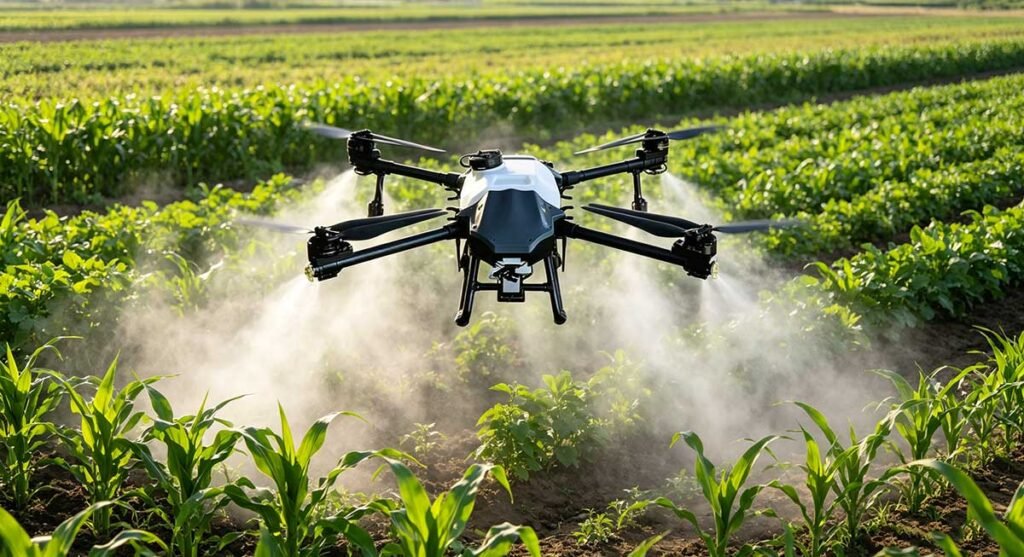
Large-scale grain farmers have found that a single drone can cover over 300 mu (approximately 20 hectares) per day, increasing efficiency by about 30 times. This exponential leap in efficiency allows farmers to quickly complete operations across the entire area within the short agricultural window, preventing small disasters from escalating into major ones.
Precision and Intelligence: Cost Reduction and Increased Income
Drones are not merely flying sprayers; they are intelligent terminals integrating navigation and sensing, enabling precise application wherever needed. This precision directly leads to resource savings and increased profits.
Resource Conservation: In Taihu County, Anhui Province, drone operations can reduce pesticide and fertilizer use by 30%-50%. Practices in Yuncheng, Shandong Province, show that drones can save over 50% on pesticides and 90% on water consumption.
Increased Income and Efficiency: Precision application improves pest control effectiveness. Through drone-based pest control, it is estimated that the loss rate from pests and diseases can be controlled to within 5%, increasing income by nearly 100 yuan per mu. In Yanggao County, Shanxi Province, the use of drones for “one spray, multiple promotions” has resulted in cost savings and increased efficiency of over 200 yuan per mu for corn, with an increase in income of over 600 yuan per mu.
More importantly, drones are collaborating with big data platforms. For example, in smart farms in Ningxia, data collected by drones is analyzed in the cloud to generate “prescription maps,” guiding precise irrigation and fertilization, achieving water and fertilizer conservation.
Breaking Terrain Bottlenecks
With their vertical take-off and landing capabilities and intelligent obstacle avoidance, drones have become a “technological lever” for breaking through terrain limitations. In apple orchards in Zhaotong, Yunnan, drones automatically plan routes and avoid obstacles, covering 200 mu (approximately 33 acres) per day, solving the problem of low efficiency caused by manual spraying.
During the citrus harvest season, farmers use drones to directly transport fresh fruit down the mountainside, traversing rugged mountain roads and significantly improving transportation efficiency. These applications demonstrate that drones have evolved from a single plant protection tool into an “aerial assistant” for the entire agricultural process in mountainous areas.
As drones become “new farming tools” in the fields, agricultural production is rapidly shifting from relying on experience to relying on data, providing solid technological support for ensuring food security and rural revitalization.